
The Charles River runs through South Natick, where the original settlement began. The river has risen out of its banks before, and a homeowner who knows what to do on the first day saves a lot of damage.
Key takeaways
- The Charles River has flooded South Natick before, in February 1886, March 2010 and July 2021.
- River water counts as Category 3, so soft materials that soaked it up are usually removed, not dried.
- Engineers said in July 2021 that the South Natick dam was never designed for flood control.
- Cut the power to wet areas first, then photograph the damage before anything is moved.
- Pumping out the water starts the job, but the framing and subfloor have to be dried to a reading afterward.
A river with a flood history
South Natick sits on the Charles River, and the record shows the river has come up before. A major flood on February 16, 1886 threatened the South Natick dam and the Pleasant Street bridge.
In March 2010 flooding damaged Speen Street south of Route 135 near the Roche Bros. entrance, and the river ran three feet over flood stage in South Natick in early April.
In July 2021 heavy rain brought the Charles to near the highest level residents had seen, with washed out roads and waterlogged yards and basements near the river.
Natick averages about 47 inches of precipitation a year, so wet seasons are a normal part of the calendar. The river reaches a flood level only when several wet weeks stack up or a storm drops a lot of rain at once.
- February 16, 1886: a major flood threatened the dam and the Pleasant Street bridge.
- March 2010: the river ran three feet over flood stage in early April.
- July 2021: near record water, washed out roads and waterlogged yards and basements.
The dam question, answered plainly
The Charles River Dam in South Natick was built in 1934 and is owned by the town. It was rated high hazard and in poor condition, and the Select Board voted 4 to 1 in November 2022 to remove it.
People sometimes ask whether removing the dam raises flood risk. In July 2021 engineers said the dam was never designed for flood control, so removing it would not raise flood risk.
For a homeowner, the point is simple. High water on the Charles has always been a rain and watershed problem, not a dam problem.
What to do in the first hours
Safety comes before belongings. River water carries contamination and a flooded basement can hide live electrical equipment.
The first hours are about protecting people, stopping new damage and recording what happened.
The first hour also shapes the claim. An insurer will want to know how high the water got, how long it stayed and what it touched, and photos taken before cleanup answer all three.
Make the house safe
These steps come before any cleanup.
- Cut the power: switch off breakers for wet rooms, or the whole house if the panel is in water.
- Stay out of standing water: it may be energized and it is contaminated.
- Shut off gas appliances if water reached them and call the utility if there is any doubt.
Record the loss
Insurance claims start with proof, and the proof disappears once cleanup begins.
- Photograph the high water mark on every wall.
- Photograph damaged furniture, boxes and appliances where they sit.
- Write down what was lost and roughly when it was bought.
How river water is handled
River water is treated as Category 3 because it carries soil, runoff and bacteria. That means more removal and stronger cleaning than a clean pipe leak.
The storm and flood cleanup team in Natick starts with extraction, then removes what cannot be cleaned and treats what stays.
Hard surfaces and solid wood framing can usually be cleaned and kept. Soft goods are the ones that go, and sorting them early keeps the dumpster from filling with things that could have been saved.
- Extraction: pumps and extractors remove standing water from floors and low spots.
- Removal: carpet, pad, insulation and drywall that soaked up river water come out.
- Cleaning: hard surfaces are cleaned and treated with antimicrobial.
- Drying: air movers and dehumidifiers run until readings match the dry standard.
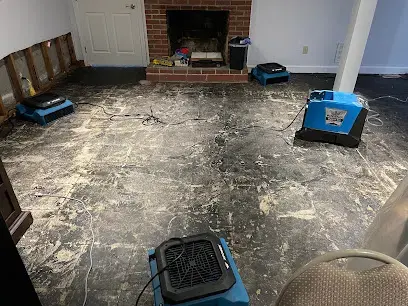
Basements near the river
The July 2021 event left waterlogged basements near the river, and a flooded basement is its own kind of job. The water is deep, the electrical equipment is close and the walls and slab hold moisture long after the water is gone.
A basement flooding cleanup in Natick pumps the basement out, maps the moisture and dries the structure to a reading.
Pumping out too fast can stress foundation walls when the soil outside is still saturated, so crews often work in stages.
Foundations and slabs also soak up water and release it slowly. That is why readings, not looks, decide when the equipment can go.
Older homes along Eliot Street and the river
Eliot Street runs parallel to the Charles River and has some of Natick's oldest homes. Older construction often has plaster, wood framing and layers of finishes that hold moisture.
Drying those materials takes patience. The drying team checks readings inside the walls, not just on the surface, and does not pull the equipment early.
Some of these homes also have storage rooms, cellars and finished lower levels that were added over the years. Each of those spaces needs its own readings.
- Older plaster: holds moisture longer than modern drywall and needs patient drying.
- Wood framing: dried in place when it can be, replaced when it cannot.
- Finished floors: checked for cupping or lifting before they are covered again.
Getting ready for the next high water
Natick became a Municipal Vulnerability Preparedness community in 2018 and worked with the Charles River Watershed Association on a flood model. The town knows the river can rise.
A homeowner can prepare too. Keep valuables off the floor, know where the main electrical panel is and test the sump pump before heavy rain.
When the water does arrive, the Natick town page lists every service the restoration team handles in town.
A few practical steps before the next high water cost very little.
- Keep a go bag of papers: insurance documents, photos and contact details in a sealed container.
- Raise stored items: boxes, tools and holiday supplies belong on shelves, not the floor.
- Test the pump: pour water into the sump pit and watch it run.
- Photograph the rooms: current photos make any claim easier.